


When comparing 7-OH kratom vs. morphine, it’s safe to say that both substances interact with the brain’s opioid receptors in ways that can lead to dependence and serious health consequences.
However, while both can produce analgesic and sedating effects through activity at opioid receptors, they differ sharply in type of substance, strength, safety profile, legality, dosing consistency, and risk factors.
In this article, you’ll learn how 7-OH and morphine compare when it comes to these criteria. We’ll also break down the biggest safety concerns and dependency risks, as knowing more about these can help you recognize the dangers right away.
What Is 7-OH Kratom?
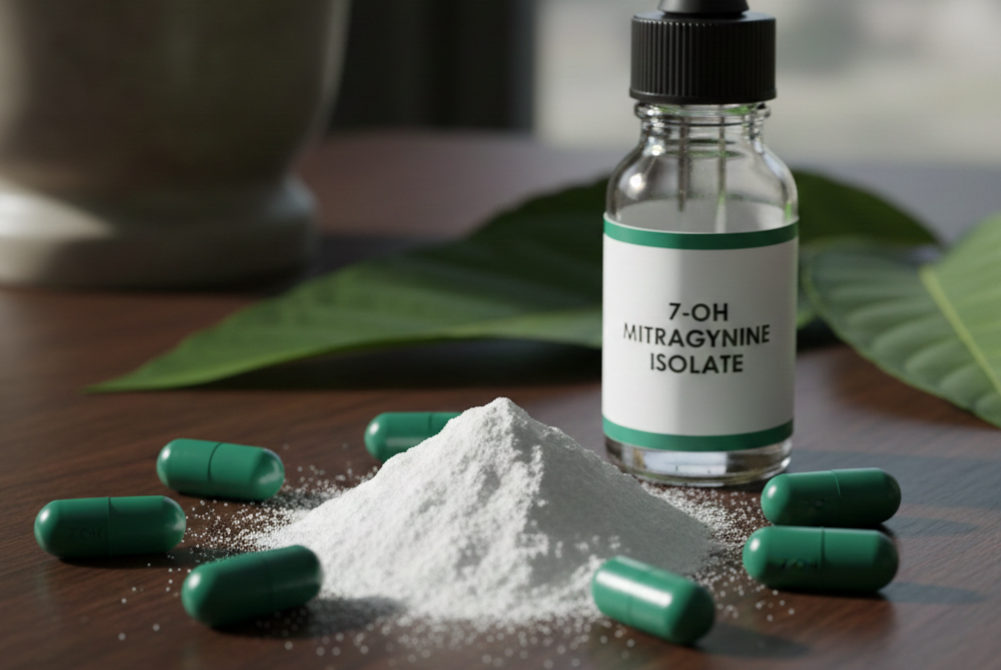
7-hydroxymitragynine, commonly called 7-OH, is a naturally occurring alkaloid found in kratom leaves. While some preclinical studies suggest it may be more potent than morphine in laboratory and animal models, its effects in humans are highly variable, and precise potency relative to morphine is not well established.
Unlike prescription medications, 7-OH is not FDA-approved or medically regulated. This means there are no standardized dosing guidelines, and products containing this alkaloid can vary dramatically in potency from batch to batch.
Many people turn to 7-OH kratom as a supposed “natural alternative” to prescription pain medications or as a way to manage opioid withdrawal symptoms. However, this approach continues the underlying dependence rather than solving the root of the problem.
The lack of regulation also means that some commercial kratom products contain artificially elevated levels of 7-OH, sometimes much more than naturally present in the plant. This dramatically increases the risk of developing dependence.
What Is Morphine?
Morphine is a prescription opioid analgesic derived from the opium poppy plant. It has been used in medical settings for over 200 years and remains one of the most effective medications for managing severe pain.
In hospitals, morphine is commonly administered for post-surgical pain, cancer-related pain, and other conditions where milder analgesics prove inadequate. Its effectiveness comes from its ability to bind strongly to opioid receptors throughout the central nervous system.
However, this same mechanism makes morphine highly addictive. The drug is classified as a Schedule II controlled substance under the Controlled Substances Act, indicating it has a high potential for abuse and dependence despite its accepted medical uses.
When used as prescribed and monitored by healthcare professionals, morphine can provide significant relief for patients with severe pain. The problems arise with prolonged use, misuse, or when people obtain it without proper medical supervision.
This leads to morphine dependence, which develops because the drug fundamentally alters brain chemistry. Repeated exposure alters opioid receptor signaling and endorphin regulation, leading to tolerance and physical dependence.
7-OH Kratom vs. Morphine: What Are the Key Differences?
The key 7-OH kratom vs. morphine differences lie in the substance type, their legal status, medical applications, and how they’re typically obtained.
#1. Substance Type
This is perhaps the most important distinction. Morphine is an opioid, while 7-OH kratom acts on the same receptors. Morphine binds directly to mu-opioid receptors in the brain and body, and its opioid classification is both pharmacological and legal.
On the other hand, 7-hydroxymitragynine (7-OH) is an alkaloid derived from the kratom plant (Mitragyna speciosa). Chemically, it is not classified as an opioid, yet it produces opioid-like effects by binding to the same mu-opioid receptors that morphine targets.
This “opioid-acting but non-opioid” status is the key reason why its risks are frequently underestimated by users.
#1. Legal Status and Regulation
Morphine is a tightly controlled prescription medication that can only be legally obtained through a licensed healthcare provider. Pharmacies must maintain strict records of every dose dispensed.
On the other hand, kratom’s legal landscape is fragmented, so kratom and 7-OH are not always treated the same under state law. For instance, Florida outlawed 7-OH while regular kratom remains legal and purchasable.
Conversely, other states have banned kratom broadly but have no specific restrictions on 7-OH. All of this creates a patchwork of regulations that can be difficult for consumers to navigate and that vendors sometimes exploit.
At the federal level, the specific 7-OH alkaloid is not regulated separately, although the FDA is recommending a scheduling action. Depending on local laws, kratom and 7-OH products may still be found at gas stations, smoke shops, and online retailers. However, legality depends on location and, crucially, the two are not interchangeable from a legal standpoint.
#2. Potency and (Opioid) Receptor Binding
When examining opioid receptor binding, both 7-OH and morphine bind to mu-opioid receptors, but their potency profiles differ in not yet fully understood ways.
Morphine is considered the gold standard reference opioid. Its binding affinity, dosing thresholds, and effects have been exhaustively studied in clinical settings, giving healthcare providers a precise and reliable pharmacological map to work from.
7-OH also binds to mu-opioid receptors and produces opioid-like effects, and early research suggests it may be considerably more potent than morphine. In a 2002 in-vitro study using a guinea pig ileum preparation, Takayama et al. found that 7-hydroxymitragynine demonstrated roughly 13 times greater potency than morphine and 46 times greater potency than mitragynine, the primary alkaloid in standard kratom products.
However, in-vitro findings of this kind cannot be directly translated into human-equivalent dosing comparisons, and large-scale clinical data in humans remains absent.
#3. Medical Use and Supervision
Morphine is administered under strict medical supervision with careful monitoring of vital signs and dosing adjustments. Healthcare providers can respond quickly to adverse effects.
7-OH kratom has no approved medical uses in the United States. People who use it do so without professional guidance, proper dosing information, or monitoring for complications.
This lack of oversight means that negative reactions to 7-OH often go unreported and untreated until serious health consequences develop.
#4. Product Consistency
Pharmaceutical morphine undergoes rigorous quality control to ensure each dose contains exactly what the label states, and this consistency is essential for safe medical use. Meanwhile, kratom products, including those containing 7-OH, have no such quality standards.
7-OH vs. Morphine: Comparison Table
Let’s summarize all the crucial 7-OH vs. morphine differences in a table:
| Factor | 7-OH Kratom | Morphine |
| Substance Type | Plant alkaloid; not an opioid but opioid-acting | True opioid alkaloid |
| Legal Status | Unscheduled federally; varies by state | Schedule II controlled substance |
| Medical Use | None approved | Severe pain management |
| Regulation | None | Strict pharmaceutical oversight |
| Potency | Potent opioid-like effects | Standard reference opioid |
| Product Consistency | Highly variable | Precisely manufactured |
| Supervision | Self-administered | Medical oversight required |
7-OH Kratom vs. Morphine: Addiction and Dependence Risk
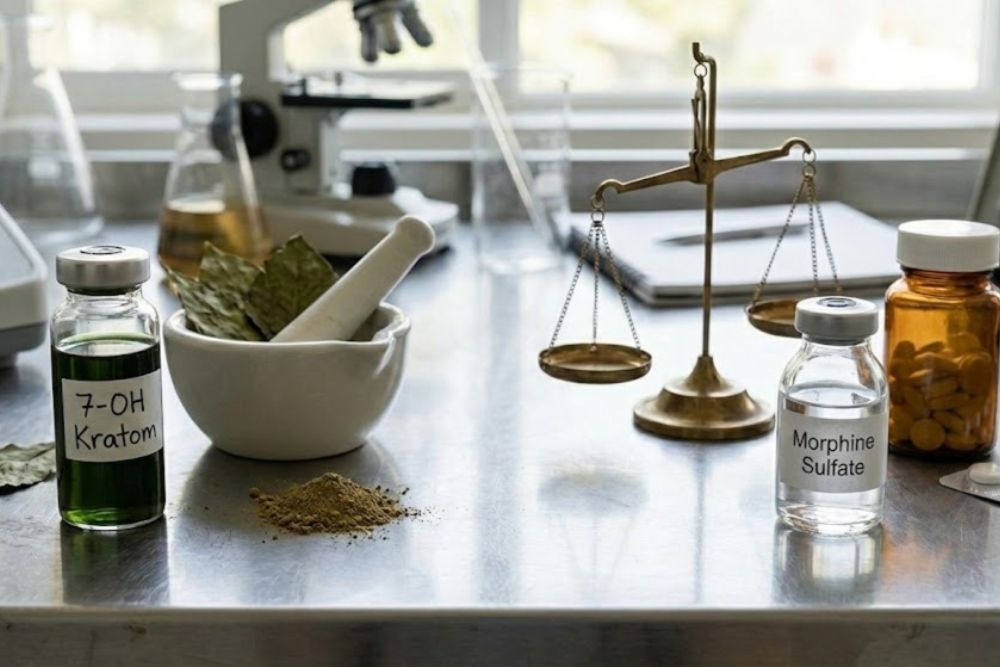
Both 7-OH and morphine carry significant risks for dependence and opioid addiction. Understanding these is essential for anyone considering using either substance or seeking to help a loved one who is struggling.
Is 7-OH Addictive?
Yes, 7-OH proves to be addictive according to in vitro studies; the compound’s strong interaction with mu-opioid receptors in mice triggers the same neurological changes that drive addiction with traditional opioids.
The 7-OH addiction risk is particularly concerning because many users don’t recognize the danger. The “natural” label creates a false sense of security that can delay intervention until dependence is well-established.
Regular use of this substance may cause the endorphin-receptor system to adapt by increasing opioid receptor density and decreasing natural endorphin production. This is the same mechanism that underlies all opioid dependence.
Morphine Dependence and Opioid Use Disorder
Morphine dependence has the potential to develop in anyone who takes the medication long enough, regardless of their personal history, genetics, or life circumstances.
The development of tolerance is often the first sign of physical dependence. Patients find they need higher doses to achieve the same pain relief, indicating their nervous system has adapted to the drug’s presence.
When morphine is stopped or reduced, withdrawal symptoms emerge because the body can no longer function normally without the opioid. These drive many people to continue using despite wanting to stop.
7-OH Kratom and Morphine Withdrawal and Long-Term Risks
7-OH kratom and morphine produce significant withdrawal symptoms, which can be severe enough to drive relapse without proper treatment when discontinued after regular use.
Physical Withdrawal Symptoms
Common physical withdrawal symptoms from either substance include muscle aches, nausea, vomiting, diarrhea, sweating, and chills. Many people describe the experience as similar to severe flu.
Fatigue and increased pain sensitivity are also common. The body, having adapted to the presence of opioids, struggles to regulate pain signals and energy levels without them.
Morphine withdrawal symptoms typically begin within 8-12 hours of the last dose and peak within 36-72 hours. Kratom withdrawal, including 7-OH, follows a similar timeline. Symptoms commonly begin within 12–48 hours of cessation, but the timing can vary widely.
Psychological Morphine and 7-OH Kratom Effects During Withdrawal
Beyond physical discomfort, withdrawal often involves severe anxiety, irritability, depression, and intense cravings. These psychological symptoms can persist longer than physical ones.
Sleep disturbances are common and can last for weeks or even months; the resulting exhaustion compounds other symptoms and makes recovery more difficult.
Many people underestimate the psychological component of opioid dependence. However, the overwhelming urge to ease suffering, combined with the discomfort of withdrawal, creates a powerful barrier to success.
Long-Term 7-OH and Morphine Opioid Effects and Consequences
Without proper treatment, the risk of relapse remains high, as simply stopping the substance doesn’t address the underlying neurobiological changes that drive dependence.
People who begin with “alternatives” like kratom or 7OH often escalate to stronger opioids over time.
Additionally, post-acute withdrawal syndrome (PAWS) can cause lingering symptoms for months after acute withdrawal ends. These persistent effects frequently trigger relapse in those who haven’t received comprehensive opioid dependence treatment.
Why “Natural” Does Not Mean Safer
The assumption that natural substances are inherently safer than synthetic ones is dangerously misleading. Many of the most addictive and harmful substances known to medicine are derived from plants.
Natural substances like 7-OH can strongly activate opioid receptors in ways nearly identical to pharmaceutical opioids. The brain doesn’t distinguish between “natural” and “synthetic” sources of opioid receptor stimulation.
Furthermore, natural products can cause dependence and withdrawal just as severe as prescription medications. The body’s adaptation to regular exposure follows the same pattern regardless of the source.
Perhaps most concerning, natural products are often unpredictable in strength and purity. Without regulatory oversight, each batch of kratom may contain dramatically different concentrations of active alkaloids, making accidental overdose a real possibility.
Treatment Options for Morphine and 7-OH Kratom Dependence
Effective opioid dependence treatment must address the underlying neurobiological changes that drive continued use; simply managing symptoms isn’t enough to achieve lasting recovery.
Traditional approaches like detoxification only remove the substance from the body without repairing the endorphin-receptor imbalance. This leads to persistent cravings and high relapse rates.
Accelerated Neuro-Regulation (ANR) represents a fundamentally different approach. Developed by Dr. Andre Waismann, this treatment targets the root cause of opioid dependence by re-regulating the endorphin-receptor system to its pre-dependence state.
While other approaches typically substitute one opioid for another, ANR treatment aims to restore normal brain function. This eliminates withdrawal symptoms and cravings by addressing the neurological imbalance rather than masking it. Therefore, for those struggling with dependence on 7-OH, morphine, or any other opioid, ANR offers a path to recovery that doesn’t require long-term maintenance medications.
Key Takeaways
The comparison of 7-OH vs. morphine reveals that both substances pose serious risks for dependence and addiction. Despite its natural origin, 7-OH kratom is not a safe alternative to prescription opioids. According to preclinical studies, it has greater potency than morphine, and the lack of regulation around 7-OH products makes them potentially even more dangerous.
Effective recovery requires treatment that addresses the root cause of morphine and kratom addiction and dependence rather than simply managing symptoms. ANR treatment offers a science-based approach that re-regulates the endorphin-receptor system, enabling lasting success without the need for ongoing opioid replacement therapy.
7-OH Kratom vs. Morphine FAQs
#1. Does 7-OH show up on a drug test?
7-OH or kratom alkaloids are usually not detected by standard opioid drug tests. However, specialized kratom tests do exist and are becoming more common in certain settings, including some employment screenings and treatment programs.
#2. Is kratom or 7-OH safer than prescription opioids?
No, kratom and 7-OH are not safer than prescription opioids. Both can cause dependence, withdrawal, and opioid overdose, and the lack of regulation actually makes kratom products potentially more dangerous due to inconsistent potency and purity.
#3. Can 7-OH cause withdrawal?
Yes, regular use of 7-OH can cause withdrawal symptoms similar to those experienced with traditional opioids. These include muscle aches, nausea, anxiety, insomnia, and intense cravings; the severity depends on the amount used and the duration of use.