

Cook County has documented severe opioid overdose burden across wide age spans (county public health reporting). Many Chicago-area patients search for “rapid detox near me”—but anesthesia-assisted rapid opioid detox is not widely marketed the way it is in some coastal markets.
Understanding Rapid Detoxification
Rapid detoxification (sometimes called AAROD or UROD) combines anesthesia or deep sedation with opioid antagonists to trigger withdrawal quickly while you are unconscious or heavily sedated. Programs often emphasize speed—a complete stay of around 48 hours including hospitalization is common in marketing materials.
Compared with medically supervised opioid detox that unfolds over longer observation periods, sedation-assisted approaches trade time compression for perioperative risks and variability in outcomes after opioids are cleared from the bloodstream.
Rapid Detox Locations and Centers in Chicago
Rapid detox in Chicago is not broadly available—you may find medical detox and medication-assisted stabilization more often than advertised sedation-assisted rapid antagonist detox. Always verify licensing, physician oversight, and level-of-care descriptions directly with each facility.
MC Medical Drug Detox Group
- Address: 171 W Monroe St., Chicago, IL 60603
- Services listed: medical drug detox (Yelp directory)
Footprints to Recovery
- Address: 411 West River Road, Elgin, IL 60123 (northwest of Chicago)
- Services: medical detox, residential and outpatient programs (Yelp directory)
Eva Mae Recovery Hope
- Addresses: 6614 S. Halsted St. Suite 102, Chicago, IL 60621; 10723 S. Halsted, Chicago, IL 60628
- Services: OTP, IOP, outpatient, and detoxification tracks (Yelp directory)
Exploring Other Opioid Addiction Treatments Beyond Rapid Detox in Chicago
Beyond sedation-assisted rapid detox, Chicago-area systems often emphasize medication-assisted treatment (MAT), inpatient medical detox, and outpatient stabilization. Traditional approaches frequently focus on withdrawal management without fully reversing the receptor-level dysregulation that can drive relapse after opioids are eliminated.
Accelerated Neuro-Regulation (ANR) treats opioid dependence as a neurophysiologic imbalance of endogenous endorphins and opioid receptors—not only as opioid clearance from the bloodstream.
What Is ANR Treatment?
ANR treatment modulates endorphin–opioid receptor balance under deep hospital anesthesia so the central nervous system can move toward equilibrium, with withdrawal symptoms addressed in that framework rather than solely by speeding antagonist-mediated detox under lighter sedation alone.
Why Consider Traveling to Florida for ANR Treatment
- ICU-level hospital setting with consistent safety standards versus variable sedation-office environments.
- Focus on repairing dependence physiology—not only completing detox.
- Short hospital stay (~36 hours for many patients) versus repeated detox attempts after relapse.
- Individualized planning for patients with complex medical histories.
ANR Success Story
“For twenty years of my life, I abused heroin and methadone… When I awoke, it was so amazing how all the pain in my body and energy came back like I was reborn again…” — Anna (Chicago).
Break the Chains of Opioid Dependence With ANR Treatment
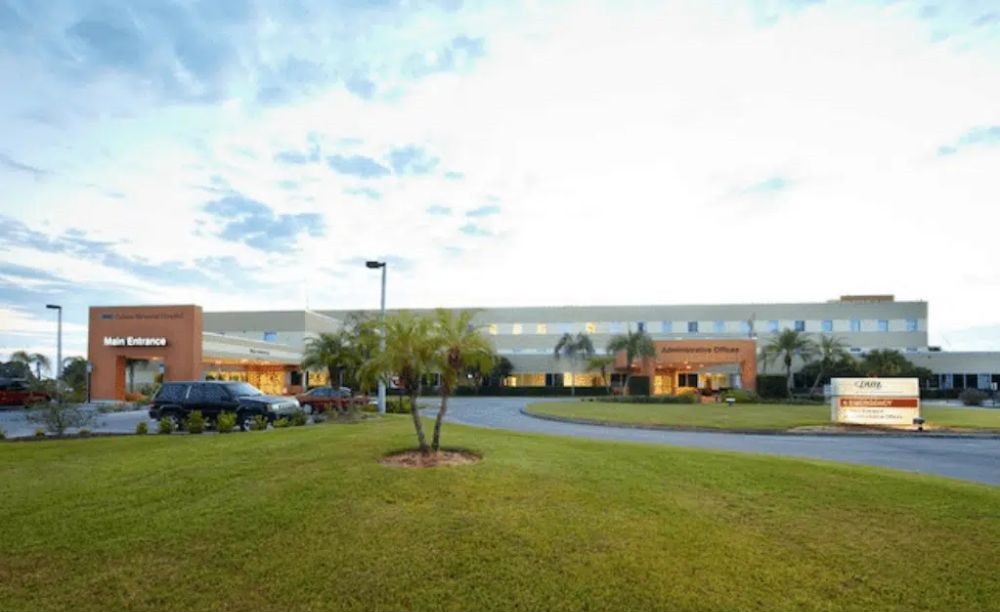
Request a complimentary consult through our contact page or call 813-750-7470. U.S. ANR treatment is performed in Florida within an accredited hospital environment.
Rapid Detox Chicago FAQ
1. How long is it safe to detox?
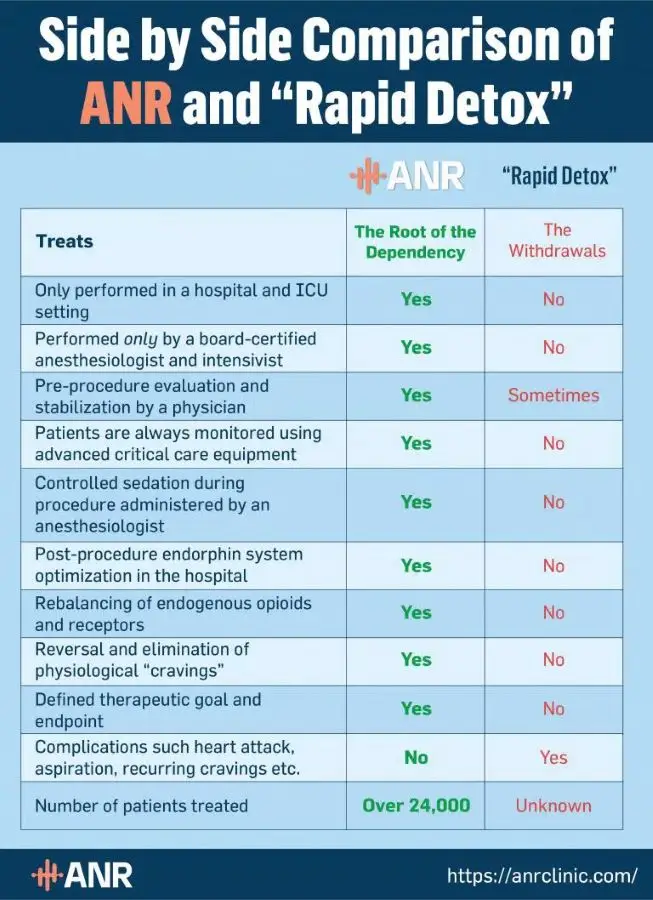
That depends on the method—some approaches marketed as detox focus on sedation and antagonists rather than gradual medical stabilization. Ultra-rapid protocols have documented severe adverse events (CDC sentinel examples). ANR addresses dependence physiology under hospital anesthesia protocols with ICU-level oversight.
2. What is the success rate of ANR vs. rapid detox?
Rapid detox often shows high relapse after short follow-up windows in published cohorts—ANR focuses on resetting endorphin–receptor balance rather than only accelerating withdrawal. See ANR vs. rapid detox.
3. How long does ANR treatment take?
The regulating procedure typically lasts several hours under anesthesia; inpatient observation aligns with perioperative monitoring standards, then patients step down toward discharge planning over the following days.
4. Is ANR covered by insurance?
ANR is usually classified as elective; we offer several financing options for qualified patients.